
March 12, 2026
How the humble signed-out page could be a missed key conversion opportunity for your website
By Dan Biggs
Learn why the signed-out page matters – and how credit unions can use this small, often overlooked, member touchpoint to deliver more engagement and value.
Credit unions across Canada all face the same growth challenges: deepening member relationships, increasing share of wallet, and staying top of mind when big banks dominate digital experiences.
Most strategies to solve these challenges fall into familiar buckets, such as email campaigns, paid media retargeting, personalized offers, in-app promos, etc. But there’s an engagement opportunity almost no one talks about: the signed-out page.
What is the signed-out page and why does it matter?
This is the page a member sees immediately after logging out of digital banking. For most credit unions, there’s no dedicated page, or the member is redirected to the homepage. That means a known member – someone who just authenticated – is sent to a generic experience with zero opportunity to deepen the relationship.
Every digital journey has an exit moment. And exit moments matter – especially when the user has just proven their identity by logging in.
This is a classic example of a UX and marketing gap that gets overlooked because it’s “behind the scenes” and not being measured, like a form or a campaign. The logout experience is often neglected, yet can be an opportunity to communicate with users, advocate your brand, and optimize user experience beyond the core task of logging out.
The signed-out page as strategic growth asset
Every digital journey has an exit moment. And exit moments matter – especially when the user has just proven their identity by logging in. Members today often expect digital experiences that mirror big brands they use daily. When credit unions leave the logout moment as an afterthought, two losses occur:
- Engagement loss: The member leaves your website without any brand reinforcement or next steps.
- Personalization loss: You know this visitor and what their intent is, yet you treat them like a stranger.
Instead, it should be treated like any other engagement opportunity:
- Confirm and reassure: Members want to know they’ve successfully logged out and their session is securely closed.
- Reinforce your credit-union value: This is a member who just used your services, not random web traffic. Use language that reinforces belonging and trust.
- Drive next-step engagement: Provide contextual opportunities, such as tools, tips, events and offers, tailored to the segment or behaviour you just observed.
- Personalize with intent: Because the member was just authenticated, you can safely personalize content (without violating privacy norms), even at a high level, e.g. “Explore these tools for your next financial step.”
By flipping the script and treating logout as part of the journey, you can:
- Extend brand messaging without high acquisition costs
- Promote financial wellness tools members might not know about
- Surface relevant products (e.g., savings boosters, low-rate loans)
- Reinforce community impact and member value
Not every growth lever needs to be dramatic. Sometimes, it’s just about making the moments you already have work harder.
Examples of high-impact signed-out pages
Here are a few real life examples of financial brands that use their logged-out pages to reinforce their brand, educate users and drive further engagement:
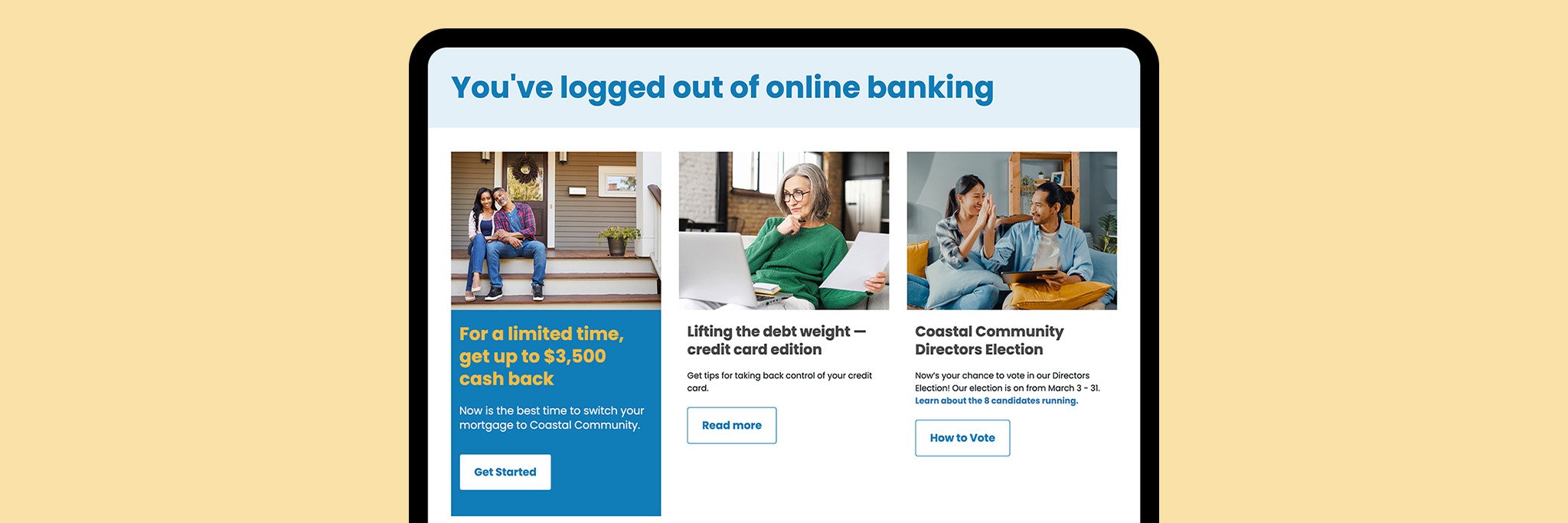
- Coastal Community Credit Union: Engages the user with offers, learning articles, member communication and fraud education.
- Khalsa Credit Union: Features promotions and educates members on digital channels.
- Bulkley Valley Credit Union: On logout members see community information, as well as education about various digital banking tools and security.
- RBC: Drives to events, FAQs, educational content and offers.
- Envision Financial: Promotes app downloads, links to offers, financial tools, and educational information about account security and fraud prevention.
Tips for transforming your signed-out page
Instead of treating logout as a dead end, treat it as a reinforcement of your credit union’s value, and another chance to keep the relationship moving forward. Here’s how your credit union can begin to make much more of this touchpoint:
- Audit your current logout behaviour: Does it redirect to the homepage? To a generic page?
- Define your objectives: Is this page for reassurance? Engagement? Cross-sell? Education?
- Align messaging with member context: Use language that ties back to their authenticated journey.
- Test iterations: Small A/B tests – different headlines, offers, and messages – can show what resonates.
- Measure impact: Track clicks, conversions, and downstream behaviour – not just page visits.
Not every growth lever needs to be dramatic, or involve a lot of work. Sometimes, it’s just about making the moments you already have work harder.

Dan Biggs
Digital Strategy & Performance
Dan has over 25 years of experience in data-driven digital product strategy, analytics, personalization and marketing automation, including:
- Head of Digital, Trigger
- Sr. Product Manager, Personalization, lululemon
- Director, Analytics, DDB Canada/Tribal Worldwide
- Manager Analytics, Shaw